MGA Opens American History Botanical Trail
Author: Sheron Smith
Posted: Wednesday, July 1, 2026 12:00 AM
Categories:
School of Aviation | Faculty/Staff | Events- Public | School of Arts and Letters | School of Education and Behavioral Sciences | School of Computing | School of Business | Students | Pressroom
Macon, GA
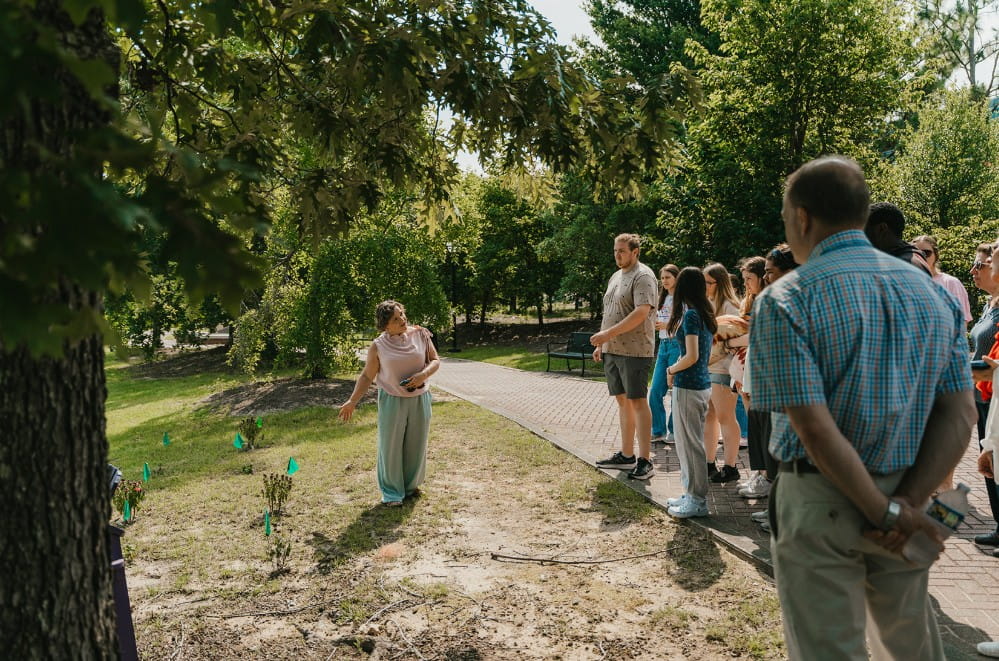
Dr. Kim Pickens Sumner talks to students, faculty, and staff about the American History Botanical Trail. See this and other images taken by Tyler White of the July 1 presentation on MGA's Facebook page.
A tree, a flower, or a medicinal herb may seem like a simple part of the landscape, but each plant has a story to tell.
At Middle Georgia State University (MGA), those stories are coming to life through the new American History Botanical Trail at the Waddell Barnes Botanical Gardens, a half-mile walking experience that will explore how plants shaped the nation’s history from its founding to the present day.
MGA held a soft opening for the trail on July 1, celebrating a project that combines history, biology, technology, and outdoor learning. The trail is being developed through National Endowment for the Humanities (NEH) funding awarded through the Celebrate America! chairman’s grants in honor of America’s 250th anniversary. The MGA Foundation provided matching support.
“We wanted to celebrate the part that plants have had in the founding of our country,” said Dr. Kim Pickens Sumner, biology professor and one of the project’s creators. “These plants were fundamental to our survival and thriving in the United States.”
The American History Botanical Trail builds on the legacy of the Waddell Barnes Botanical Gardens, which have been part of MGA’s Macon Campus since its establishment in 1968. The campus features a variety of plants and trees that collectively make up the gardens, and MGA eventually named them in honor of Dr. Waddell Barnes, a retired physician and plant enthusiast who helped champion their development and also served the institution as a Foundation trustee.
“What we wanted to do is basically add to what is already here,” said Pickens, whose project collaborators include Dr. Matt Jennings, history professor; Dr. Tyler Achatz, director of grants and sponsored projects; and Tyler Austin, who worked at MGA as grounds manager.
“So we’ve developed a walking trail that highlights certain plants and how they were used during particular periods of the nation’s history.”
The trail is a half-mile accessible loop that winds around the lake near the Jones Building and includes five garden areas representing different periods of American history. Each section features plants connected to that era and explores how those plants were used medicinally, agriculturally, industrially, culturally, and environmentally.
The five sections include:
- The Founding Era, highlighting plants and trees that supported early communities through food, medicine, and daily life. For example, the information included about an American chestnut in this section will explain how Indigenous communities made use of these trees for food and to attract wildlife.
- Civil War, Reconstruction, and Westward Expansion, exploring plants connected to agriculture, healing traditions, and economic development.
- Industrialization and the Progressive Era, focusing on changing relationships between plants, science, and industry.
- Depression, War, and Modernization, examining how plants remained important during periods of hardship and national transformation.
- Contemporary America, Conservation, Heritage, and Wellness, highlighting the continuing importance of plants in environmental stewardship and modern life.
For Jennings, the trail tells a larger story about the relationship between people and the natural world.
“The story of the use of plants in American history parallels the steps of European colonies in North America, the rise of the United States for continental power, an industrial and economic power, and eventually a world power,” he said.
But the story does not begin with the founding of the nation. Long before 1776, Native Americans, Europeans, and Africans were interacting across the continent, bringing with them different relationships with plants and different traditions for using them.
Throughout the trail, visitors will encounter examples of those connections.
The project will incorporate technology to create a more interactive experience. Visitors will be able to scan QR codes located throughout the trail to access a dedicated website (to be launched soon) featuring information about each garden, historical context, plant descriptions, images, and educational resources.
MGA will continue to develop the American History Botanical Trail and host more events this fall as the gardens mature and new resources are added. As Jennings said, the trail is an ongoing invitation to continue learning about the connections between people, plants, and the environment.
“Historians are not generally known for their ability to predict the future,” he said. “But I think it's safe to say that our understanding of America's botanical history grows. This new (trail) garden will grow, too. I'm looking forward to seeing that happen.”