Twenty-Five Years Later, MGA Professor Remembers The Day He Documented United 93’s Crash Site
Author: Sheron Smith
Posted: Monday, August 24, 2026 12:00 AM
Categories:
School of Computing | Faculty/Staff | Pressroom
Macon, GA
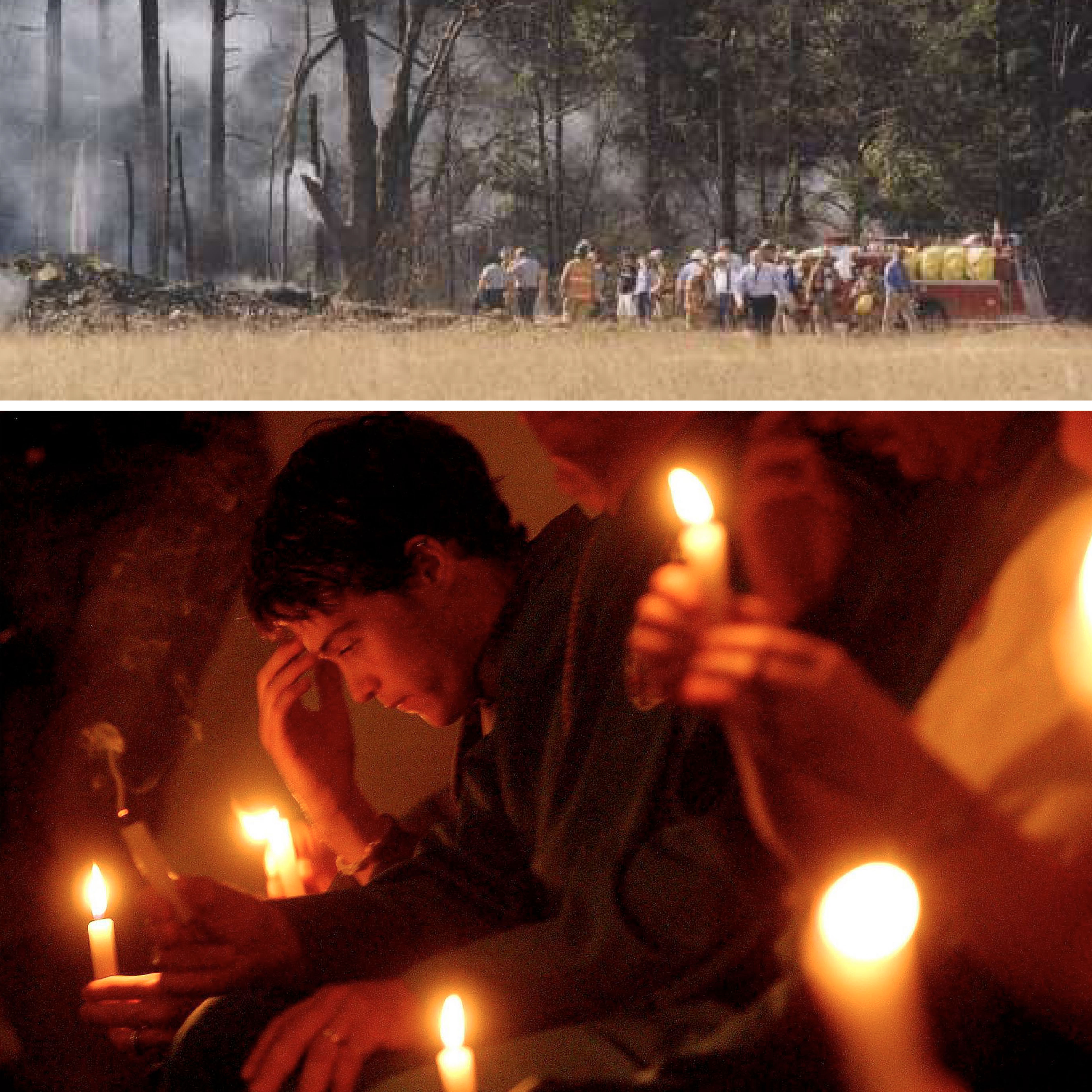
Scott Spangler took the top image moments after arriving at United 93’s crash site on September 11, 2001. The bottom image showing a memorial vigil is one of many he took in the weeks that followed. See more of his photos, all originally taken for the Tribune-Review newspaper based in western Pennsylvania, on Middle Georgia State University’s Facebook page.
As a photojournalist, one of Scott Spangler’s favorite assignments was capturing “slice of life” stories about the people, places, and culture of small towns.
That’s what brought him to Shanksville, Pa., on September 11, 2001.
Spangler was 29 years old and working as a photographer for the Tribune-Review newspaper, based in western Pennsylvania. A native of the state, he lived near Shanksville and knew the area well. He was working on a feature, searching for images that captured what made the town unique.
“It was a very diverse, small community in rural Somerset County,” said Spangler, now a professor of information technology at Middle Georgia State University (MGA). “There were Amish who had moved there and were sort of rejuvenating some strip-mined areas. It was a town full of good, hardworking people, a place where families gather for Sunday night spaghetti dinners.”
On the morning of 9/11, Spangler began hearing chatter on his police scanner about a missing plane. He grabbed his camera equipment and headed to the nearby airport in Latrobe.
Though some details from that day have blurred over time, Spangler does not believe he yet knew the full scope of what was happening in the country. He does remember standing beneath the airport’s control tower and being able to hear the tower specialist over the scanner.
“There’s a plane!” Spangler recalled hearing. And then, “My God, it’s down! It’s down! I can see the smoke!”
The plane was United Airlines Flight 93, one of four commercial airliners hijacked by terrorists on 9/11.
After passengers and crew members aboard United 93 learned through phone calls that other hijacked planes had already struck the World Trade Center and the Pentagon, they attempted to retake control of the aircraft. Investigators later concluded that their actions prevented the plane from reaching its intended target, believed to have been either the U.S. Capitol or the White House.
The Boeing 757 crashed into a reclaimed strip mine near Shanksville and killed all 40 passengers and crew members aboard, as well as the four hijackers.
Spangler knew the area’s back roads and immediately took them toward the crash site.
He was among the first journalists to arrive. Just a few other people, including some firefighters, were at the scene.
It was what wasn’t there that shook Spangler.
“There was no plane,” he said. “I was looking for a wing, a tail. I was looking for a big plane. And there was nothing.”
Instead, he saw a large impact crater and a burning tree line.
“It was just this pit, this line of smoke,” he said. “It was surreal.”
As more emergency responders and others arrived, the quiet rural area quickly became the center of a global news story. Spangler’s photos, which he took on 9/11 and for many weeks afterward, were transmitted to the Tribune-Review and distributed through news organizations around the world.
“Who outside of Shanksville had heard of Shanksville before that?” Spangler said. “Then suddenly, the world was there.”
The photos he captured in the days following the crash tell a larger story than the wreckage alone. They show a community confronting unimaginable loss while coming together in remembrance.
Some images document the smoking impact site. Others capture ordinary remnants from the wreckage, including an invoice or bill burned around the edges. Still others show people with bowed heads and clasped hands gathering for impromptu vigils in the days that followed.
Spangler remembers wearing the same clothes for days on end and at some point realizing he needed a haircut. On his way home one afternoon, he stopped at a haircutting place in a small shopping center.
“It was the first time without a camera in my hand and a notepad and a pen, and I’m thinking, ‘What’s next? Where do I go next?’” he said.
As he sat in the chair, surrounded by people watching news coverage of the attacks, the reality of the moment hit him. For the first time since everything began, he allowed tears to flow.
The woman cutting his hair paused. “Are you ok?” she asked.
“I don’t know,” Spangler replied. “I was there. I’m a photojournalist for the Trib and I’ve just been there.”
At that moment, he said, “I recognized I was part of something bigger and that’s when everything really hit me the hardest.”
A quarter century later, Spangler, now 54, is far removed from that time and those experiences.
He eventually left newspapers and photojournalism, did some adjunct teaching, and took a job as a marketing and communications specialist at a small college, where he got to know many of the faculty. They inspired him to pursue a teaching career in higher education.
He earned a Doctor of Science in Information Systems & Communications from Robert Morris University in 2015 and met Dr. Alex Koohang, the now-retired dean of MGA’s School of Computing, at a conference.
Spangler ended up joining MGA’s faculty in 2016 and is today a popular and respected professor in the School of Computing. His research focuses on how digital culture uses technology and emerging innovations. Earlier this year MGA gave him the “Excellence in Scholarship” award for his significant contributions to research, grant writing, and academic collaboration. He is also a 2026 Georgia Governor’s Teaching Fellow.
“Scott’s background is unique,” said Dr. Kevin Floyd, the School of Computing’s interim dean. "He brings more than technical expertise to the classroom. He brings the perspective of someone who has documented history, worked as a journalist and storyteller, and understands how technology shapes the way we communicate. Our students benefit tremendously from that experience."
On the 10th anniversary of 9/11, Point Park University, where Spangler earned his bachelor’s and master’s degrees, hosted a display of many of the photos he took, and he participated in a discussion and Q&A about his experiences on that pivotal day and the weeks that followed.
Aside from that, Spangler has largely kept his memories of Shanksville in the background. But as the 25th anniversary of 9/11 approaches, he finds himself reflecting on that time more often.
Not too long ago, accompanied by his father, Spangler returned to Shanksville for the first time since the tragedy.
What struck him most was not what he remembered, but what had changed.
“The memorials are beautiful and patriotic, even joyful,” he said. “Now people bring their children there to walk and hike and they see this beautiful field, these rolling meadows, and the vibrant farming happening now.
“In a way, it’s like the destruction of the landscape from strip mining and all the chaos of 9/11 has been rinsed away. I think that’s probably a good thing.”