What Super El Niño Could Mean for Georgia This Winter: MGA Faculty Q&A With Dr. Tom Hancock
Author: Sheron Smith
Posted: Monday, September 14, 2026 12:00 AM
Categories:
Pressroom | School of Computing | Faculty/Staff
Macon, GA
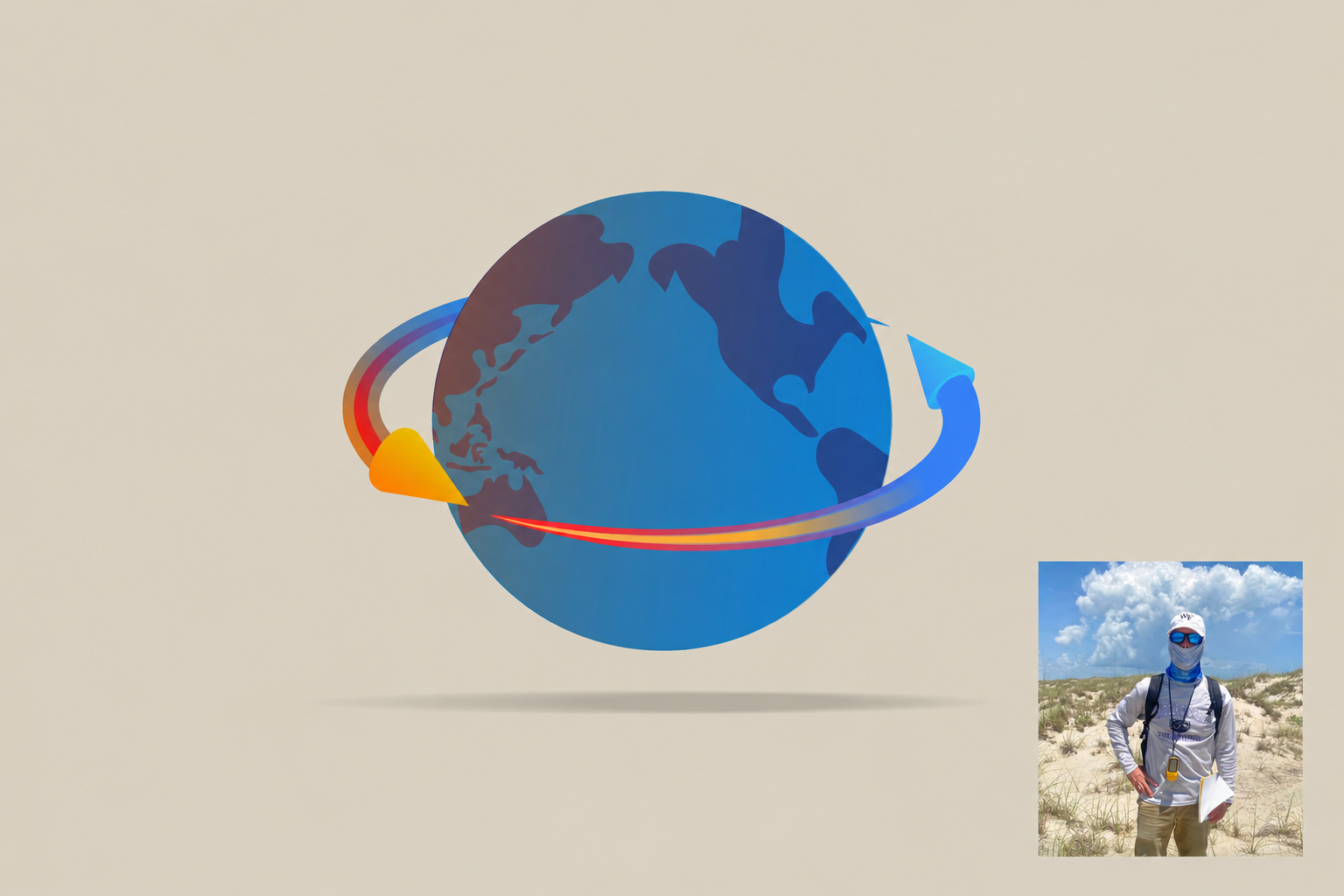
Inset: Dr. Tom Hancock doing field work at Fort Fisher, N.C., with MGA students.
“Super El Niño” is one of the trending weather stories as meteorologists look ahead to what could be an unusually active winter. But what exactly is El Niño, and what could it mean for Georgia? Dr. Tom Hancock, associate professor of biology, explains the science behind this climate pattern, why Georgia could be in for a wetter and colder winter, and what Georgians should know if snow and ice make an appearance.
What is El Nino and what effect does it have on our weather?
El Nino is part of a larger weather cycle known as the El Nino Southern Oscillation (ENSO). The core component of ENSO is a large warm pool of water in the Pacific Ocean. During most years, atmospheric winds push the warm pool of water away from the West Coast of the United States towards Tahiti and Indonesia. However, on a somewhat regular cycle (usually every 3-5 years), for reasons not fully understood, the atmospheric winds weaken allowing the warm pool of water to move back across the Pacific toward our West Coast. This is called El Nino (named for its occurrence close to Christmas oftentimes).
ENSO illustrates the interconnectedness of the ocean and the atmosphere both of which drive our weather and climate. This is super complicated stuff as evidenced by our inability to make accurate weather forecasts more than 48 hours or so in advance. The movement of warm water back toward our West Coast diverts the jet stream from Canada southward into the middle and southern United States. This brings intense storms, heavy rains, and if it’s the right time of year, large amounts of ice and snow.
What is a Super El Nino and what could it mean for Georgia this winter in terms of rain, temperatures, and the possibility of snow or ice?
Super El Nino occurs when water temperatures increase by more than four degrees Fahrenheit (roughly 2 degrees Celsius) over a non-El Nino state. Temperature is a measure of energy in a substance. So, the higher the temperature the more energy available to do work. Water that is warmer has more energy and therefore the effect of El Nino is amplified (hence ‘Super’ El Nino). This year’s El Nino is projected to be the warmest on record, possibly making a cold, icy, and snowy winter in Georgia that much colder, icier, and snowier.
Why is North Georgia considered something of a “battleground” during a strong El Niño, and could Middle Georgia see any of the same effects?
Georgia is ‘nicely’ positioned right where the southward deflected jet stream collides with warm, moist air coming up from the Gulf of Mexico. This usually results in larger precipitation amounts. I do not think Middle Georgia will have the same experience as the North Georgia mountains this winter, but we are always on the edge, therefore I expect colder temperatures, more rain, ice, and possibly snow than normal. Perhaps this is the winter we will see some appreciable snow accumulations?
For Georgians, what are the biggest things to watch for this winter, and how should people prepare for a potentially wetter and more active winter?
I am from North Carolina. People from New Jersey make fun of North Carolina drivers in winter weather, but we North Carolinians make fun of Georgia drivers. All this is to say, listen to the weather reports (they are pretty decent 48 hours out), always have food and water stored at home, and a way to stay warm if the power goes out. Don’t freak out on the road. If you need to drive, drive carefully. If the weather is dicey think twice before venturing out. Check in on your neighbors and enjoy some possible sledding in Middle Georgia.
Dr. Tom Hancock is an associate professor of biology at Middle Georgia State University. Before MGA, he was the assistant director for academics at The University of Georgia Marine Institute on Sapelo Island where he taught marine biology, research methods, and coastal ecosystems. Hancock has also taught a variety of biology courses at Gordon State College, Guilford Technical Community College, Salem College, and Methodist University as well as worked for Carolina Biological Supply Company, the Bald Head Island Conservancy, and served as an intelligence officer in the Navy Reserve. He received a B.S. in biology from UNC Charlotte, M.S. in marine biology from UNC Wilmington, and Ph.D. in biology from Wake Forest University. His research interests include dune plant ecology, estuarine invertebrate ecology, coastal and freshwater ecosystems.