MGA Computer Science Students Developing App To Enhance Macon Christmas Lights Experience
Author: Sheron Smith
Posted: Thursday, October 29, 2026 12:00 AM
Categories:
Events- Public | Pressroom | Students | Faculty/Staff | School of Computing
Warner Robins, GA
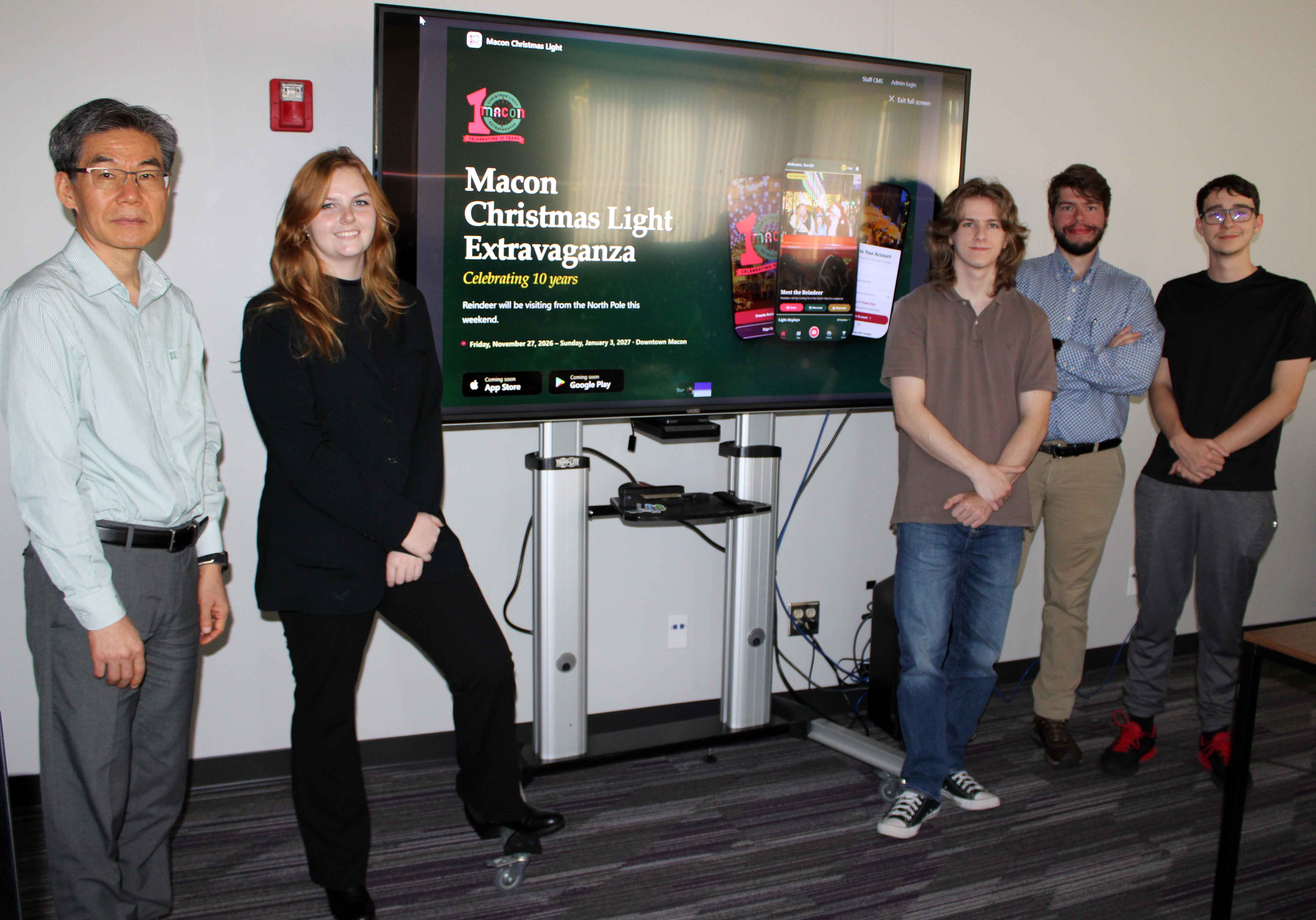
L-R Dr. Myungjae Kwak and some of the computer science majors working on the Macon Christmas Light Extravaganza app - Alaina Brown, Peyton Colabine, David Senseney, and A.J. Dreslinski. All are active members of the CompSci Knights student organization, which meets every week at the Warner Robins Campus
When thousands of visitors head downtown this holiday season to see the Macon Christmas Light Extravaganza, they’ll have a new way to explore the displays, discover local businesses, and earn prizes, thanks to a team of computer science students at Middle Georgia State University (MGA).
The students, working with professors, are developing a mobile app designed to make navigating the popular holiday attraction easier and add a little friendly competition to the experience. The 10th annual Christmas Light Extravaganza, which features more than a million lights synchronized to music by the Macon Pops, runs November 27, 2026, through January 3, 2027.
“I’ve never developed an app before,” said Alaina Brown, 20, a junior from Centerville majoring in computer science and applied AI. “It’s been a really fun experience to get to do that alongside a team.”
The app, which the team plans to finish by November 13, will combine an interactive map, a scavenger hunt, and information about local restaurants, shops, and events. Visitors can use it to find their way between displays, check in at locations, upload photos, and collect points toward prizes donated by event sponsors.
For Dr. Myungjae Kwak, chair of MGA’s Department of Computer Science, the project offers an opportunity to put classroom learning to work in a way that benefits both students and the community.
“It’s basically a companion app with some gaming features,” Kwak said.
The idea grew out of some meetings that representatives of MGA had with Bryan Nichols, the mastermind behind the Macon Christmas Light Extravaganza, to discuss sponsorship opportunities and other ways the University could help. One result was the Department of Computer Science, based on MGA’s Warner Robins Campus, offering to develop an app to improve the visitor experience.
The goal is to help people discover more of the downtown light attractions instead of visiting only the best-known displays.
“There’s so much to see, and sometimes people get lost and don’t know where to go next,” said app team member Peyton Colabine, a 21-year-old senior from Warner Robins majoring in computer science with a concentration in human-computer interaction.
The app is designed to address that problem by showing visitors the locations of the displays and helping them find their way from one stop to the next. Users can see which displays are nearby or select a specific destination, such as the Christmas market, and get directions.
The app will also feature photographs and information about individual displays, making it easier for families to decide what they want to see. Beyond the lights, visitors can explore information about nearby restaurants and shops, including reviews and other details, as well as find special events taking place throughout the season.
“People can visit the displays with their family and take pictures and earn points toward prizes,” Brown said.
To participate in the scavenger hunt, visitors can check in at displays and upload photos through the app. Some stops may include additional activities, such as scanning a QR code. Points accumulate as users complete activities, giving them opportunities to qualify for prize drawings and earn rewards such as gift cards.
The app will also include a photo gallery. Images submitted by visitors will be reviewed before they can be shared with the wider community.
For MGA computer science students, the project has provided a chance to build something people can use beyond the classroom. Working with Kwak and others, they are gaining experience with the many stages of app development, from designing the screens users see to building the systems that store information and process requests behind the scenes.
Brown said she initially became interested in designing websites and has enjoyed applying those interests to the app. The experience has strengthened her interest in pursuing a career as a software engineer. She also values the opportunity to work collaboratively and contribute to a nonprofit organization.
Colabine likewise said the project has helped him develop technical skills while learning more about how software works in a real-world environment.
“It's nice to be able to work on something that will have an impact and that people actually use,” he said.
Kwak said the students are doing more than creating an attractive interface for a phone. They are also building the app’s underlying systems, which manage the information and manage the constant exchange of requests between the app and its servers.
That combination of front-end and back-end development gives students experience with the interconnected parts of a working software application.
Kwak said the experience should help MGA computer science majors prepare for their future careers while showing them how their technical knowledge can address practical needs.
“Projects like this help students see that computer science is not just about writing code,” he said. “It’s about understanding people’s needs and creating solutions that make a difference in the real world.”